Dual laser engraver: do you need two laser sources?
A dual laser engraver combines two laser sources in one system, usually to handle materials that respond differently to each source. Common combinations include blue diode with infrared, blue diode with fiber, and CO₂ with fiber. The right choice depends on your materials, required finish, work area and production workflow.
The label alone tells you little about capability. A compact diode-and-IR engraver, a fiber-and-diode galvo and a large CO₂-and-fiber platform can all be sold as dual-laser systems. Compare the two sources separately before comparing the machines.
What does dual laser actually mean?
Ask what is doubled: the source, the processing head or the tube. Those arrangements solve different problems.
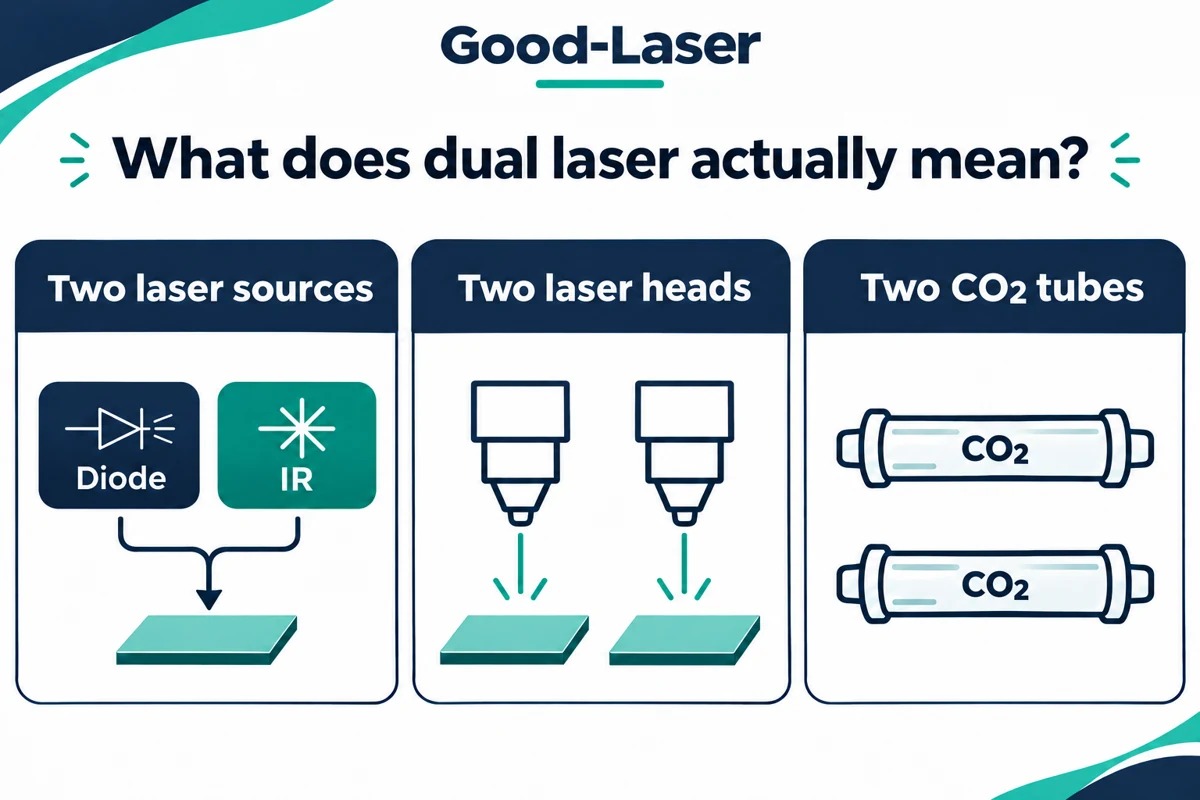
| Term | What it describes | What it does not establish |
|---|---|---|
| Dual source | Two laser sources in a system, often with different material capabilities | That both run simultaneously or have identical work areas |
| Dual head | Two processing heads | That the heads use different wavelengths or can run independent jobs |
| Dual tube | Two laser tubes, often CO₂ | That the machine includes a fiber source for metal marking |
| Interchangeable module | A platform accepting different laser modules | That both modules are installed, aligned or ready at the same time |
Some integrated machines route both sources through shared optics. Other platforms use separate heads or require a module change. Official dual-source optical documentation describes one CO₂-and-fiber design using a beam combiner. That architecture should not be assumed for every machine carrying the dual-laser label.
Ask the supplier to show the source-selection process in the software and on the machine. Confirm whether a mixed-material job needs repositioning, refocusing, a lens change or a different fixture.
Compare the common dual-source combinations
Each combination offers a different balance of material coverage and processing capability. An infrared wavelength label is not a complete description of the laser source.
| Combination | Reason to consider it | What to verify |
|---|---|---|
| Blue diode + low-power IR | Compact personalization across suitable organic materials and selected metal surfaces | IR source technology, optical output, mark depth and complete job time |
| Blue diode + fiber | Metal marking alongside wood and other diode-compatible projects | Fiber pulse control, useful area and the diode's cutting limitations |
| CO₂ + fiber | Non-metal cutting and engraving alongside metal marking | Source-specific work areas, optics, focus and the installed system cost |
| Two CO₂ sources | Different CO₂ processing characteristics or a machine-specific production arrangement | What the two tubes actually improve for the intended job |
Blue diode engraving systems commonly use visible blue light. Compact IR marking modules and many fiber marking lasers operate near 1064 nm, while a common CO₂ engraving wavelength is 10.6 µm. Similar wavelengths do not make two sources equivalent: optical power, pulse energy, duration, repetition rate and focus also affect the result.
In particular, “IR” is a wavelength category. It does not by itself mean that a module is a fiber laser. Likewise, MOPA describes a source architecture and should not be inferred from a product's color-marking demonstration. Request the actual source specification.
Manufacturers also offer systems that use wavelengths sequentially or simultaneously. The multi-wavelength processing explanation from Universal Laser Systems shows why these modes depend on the optical design and process controls. Do not assume that two rated powers can be added to describe a useful cutting output.
Match both sources to your materials
Write a material-and-result list before making a shortlist. “Metal” could mean removing a coating, adding a readable surface mark or removing enough material to create a recessed engraving. Those jobs need different evidence.
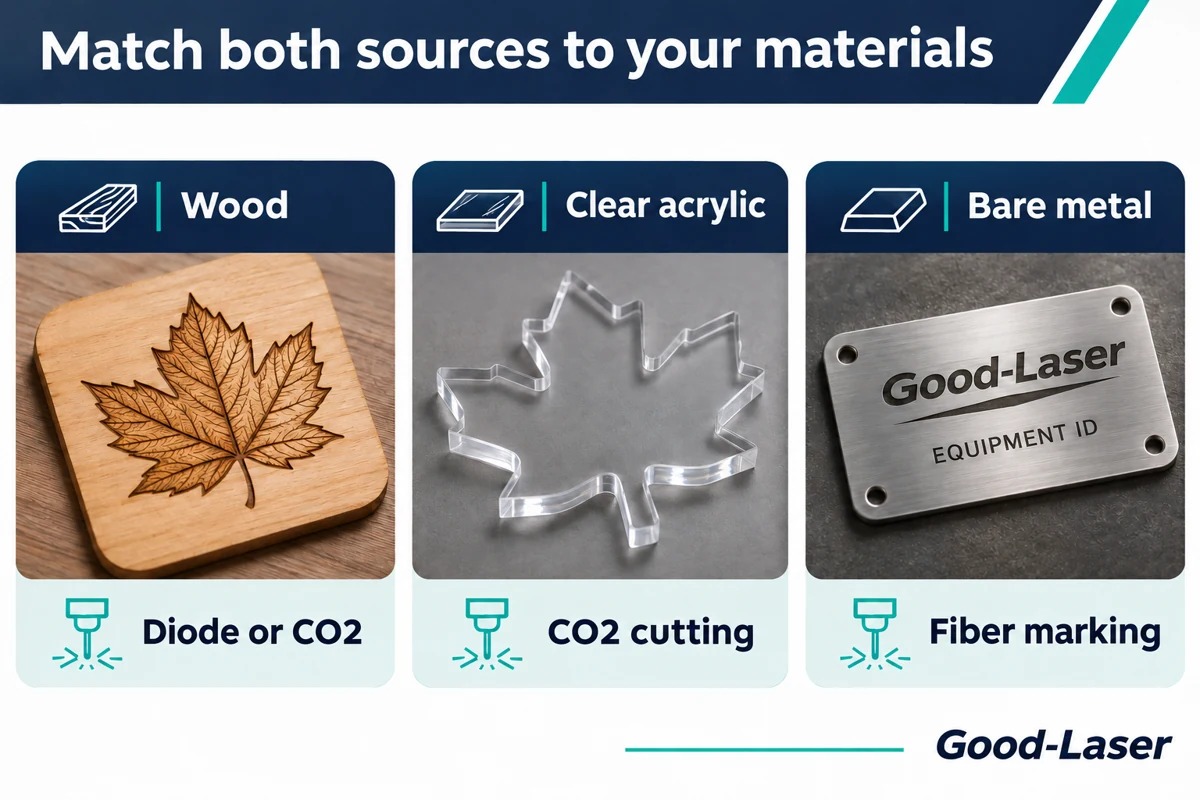
Wood, leather and craft materials
Blue diode and CO₂ systems are common starting points for suitable wood products. Cutting thickness, edge quality and engraving appearance depend on the exact stock and process. For leather, coatings and composition also need approval before testing. A broad list of compatible materials does not replace the material supplier's information.
If most work is wood personalization, a standalone blue diode laser engraver may be enough. A second source becomes useful when it serves work you can identify and sell.
Clear acrylic
Clear acrylic cutting is an important distinction between configurations. CO₂ is the normal starting point for this job. A system combining a blue diode with a compact IR marking source should not be treated as an equivalent clear-acrylic cutter. Require a cut sample at the intended thickness, with the edge finish and cycle time recorded.
Bare and coated metals
For direct marking or engraving of bare metal, evaluate an appropriate fiber configuration and the specific alloy. Removing a painted or anodized surface is a different process. The fact that a machine makes a visible mark on a coated tumbler does not prove that it can engrave the underlying metal to a specified depth.
For industrial identification, define contrast, durability and readability as acceptance criteria. A qr code laser engraver sample should be checked with the intended reader and after any relevant finishing step.
Glass and stone
Suitable CO₂ systems can produce surface effects on glass and stone, but composition and surface finish strongly affect the result. Some other sources and surface-preparation methods can work for particular applications. Test the actual item and distinguish a surface mark from cutting, deep relief or an image inside transparent material.
Check the usable work area and complete job time
The relevant work area is the space available to the chosen source with the required fixture installed. A headline maximum may depend on an extension, a different lens or several separately positioned sections.
Ask for the usable area for both sources, the maximum item height and any fixture restrictions. If a wood plaque includes a metal plate, establish whether both parts can be processed in place and whether their surfaces require different focus heights.
Galvanometer systems steer the beam with mirrors; gantry systems move a head across the work area. Their advertised maximum speeds are not directly comparable measures of finished throughput. Artwork coverage, resolution, acceleration, multiple passes, loading and inspection all affect the job.
Use the same test file and acceptance standard for competing configurations. Record setup, source switching, engraving, cleaning and inspection time separately. Ask for a complete batch demonstration if repetitive loading is central to the business.
One dual-source machine or two separate machines?
An integrated machine can reduce floor space and material handling for certain jobs. Separate machines can provide more independent capacity and allow each workstation to suit its main task.
| Decision | Integrated dual source | Separate machines |
|---|---|---|
| Available space | May consolidate equipment, subject to extraction and service clearance | Requires space and utilities for each workstation |
| Mixed-material item | May reduce transfers if the system supports the job | Needs fixtures or a reliable way to transfer the item |
| Independent orders | Often share one processing area or job queue | Can run concurrently with suitable staffing and controls |
| Maintenance | A shared-system fault may affect both processes | One machine may remain available when the other is serviced |
| Expansion | Depends on supported configurations and accessories | Each workstation can be upgraded independently |
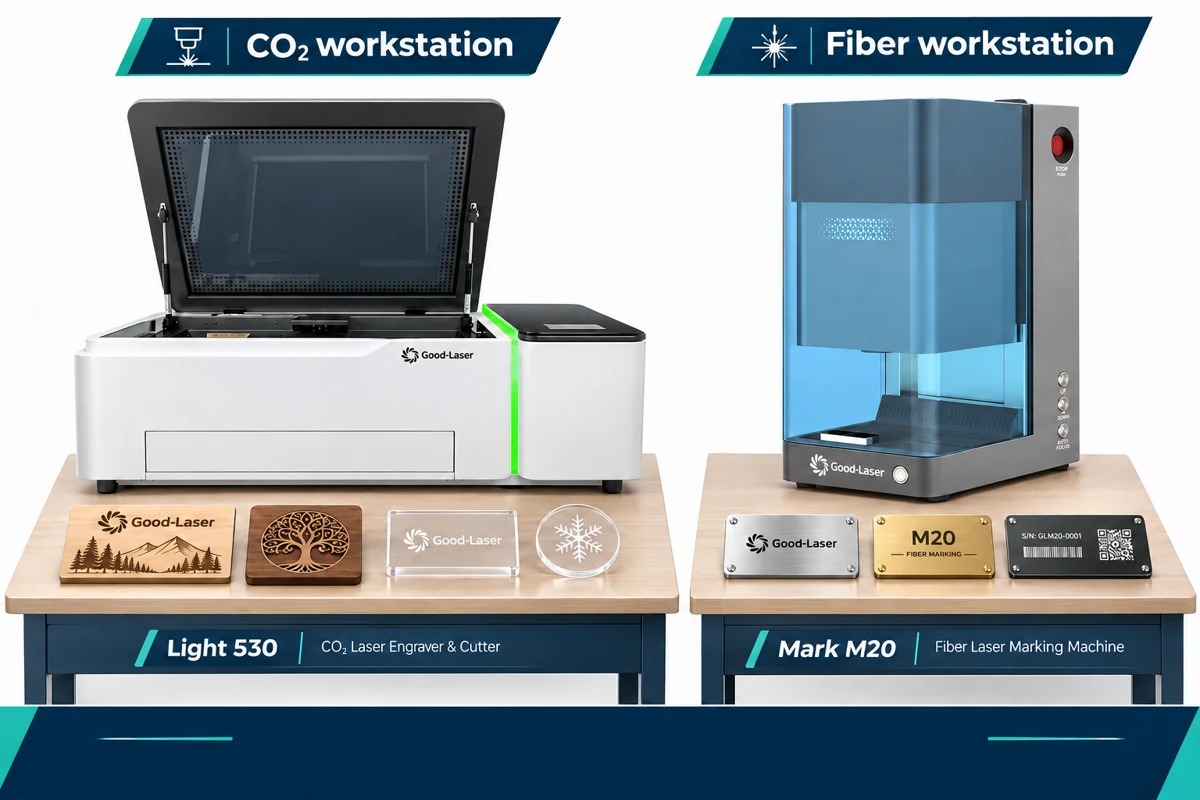
Good-Laser's Light 530 is a CO₂ machine and Mark M20 is a fiber marking machine. They provide a way to discuss separate non-metal and metal workflows. They should not be described as one integrated dual-source product. Their combined suitability still depends on samples, fixtures and the proposed production schedule.
A shop producing large acrylic signs and small metal tags may benefit from independent machines. A compact operation personalizing small items on demand may place more value on a single footprint. Compare these choices using the orders you expect to receive.
Compare total cost and the work the second source will earn
Price the complete configuration, including the sources, enclosure, extraction, required cooling, lenses, fixtures, software and delivery. Confirm which items are optional and which are required for your applications.
The guide to how much does a laser engraver cost can help organize the discussion. For the business decision, use the same assumptions for both the integrated and separate-machine quotes.
Estimate the additional contribution from orders that genuinely need the second source. Deduct their materials, labor, processing costs, selling fees and expected rework. Then compare that contribution with the extra fixed costs and investment. Do not count every existing order as new revenue from the second source.
If uncertain demand is the main reason for adding a source, first obtain sample orders or outsource a limited batch. The best laser engraver for small business criteria can help distinguish a material requirement from a capacity requirement.
What to request in a dual-laser demonstration
Send actual blanks and a small set of representative files. Include the most difficult material, the largest intended artwork and any mixed-material assembly.
- A finished sample from each source, with material, finish and configuration identified.
- The optical output and source technology for each laser, without relying on combined marketing wattage.
- A demonstration of switching, focus, positioning and file preparation.
- Complete cycle time, including handling, for an accepted result.
- Usable work area and height with the proposed accessories installed.
- Software support, license requirements, extraction, maintenance and service arrangements.
For metal color effects, define the appearance, alloy and viewing conditions, then test repeatability. A color palette on one sample does not establish identical results on another alloy or finish.
Confirm that the supplied enclosure and operating procedures cover both sources. Invisible radiation requires the same attention to appropriate protection and interlocks as visible light. Follow the manufacturer's documented controls and arrange suitable extraction for the material being processed.
Frequently asked questions
Is a dual laser engraver better than a single-source machine?
It is more useful when the second source handles a defined part of your work. A single-source machine can be the better fit when almost all orders use one material process, or when a larger work area matters more than additional material coverage. Compare accepted samples and complete order capacity.
Is a 1064 nm IR module the same as a fiber laser?
No. A wavelength describes the emitted light, while fiber identifies the laser technology. Different source designs can emit near 1064 nm and have very different optical power and pulse characteristics. Ask for the source specification and a sample showing the required result on your material.
Can the two lasers work at the same time?
That depends on the platform. Some switch between sources; others support specific simultaneous processing modes. A shared housing or two-source specification does not establish parallel production. Ask the supplier to demonstrate the intended workflow and distinguish simultaneous processing of one job from two independent jobs running at once.
Can a dual laser cut clear acrylic and engrave metal?
A suitable CO₂-and-fiber configuration can address those two processes, subject to material and machine limits. A diode-and-IR configuration should not be assumed to offer the same acrylic cutting capability. Specify the acrylic thickness and metal marking requirement, then request separate accepted samples for each job.
Can I add the wattages together?
Do not use the sum as a substitute for source-specific capability. A 20W diode and a 20W fiber source perform differently and do not automatically become a 40W cutting laser. Even systems designed to combine wavelengths require a process-specific assessment of how the material absorbs the energy.
Does Good-Laser offer these functions in one dual-source machine?
The Light 530 and Mark M20 discussed here are separate CO₂ and fiber machines. Treat them as independent workstation options. If you require an integrated dual-source platform, ask Good-Laser to confirm current availability and provide a written configuration specification before making a procurement decision.
Choose a Good-Laser workflow around your samples
Send the good laser team your material list, artwork dimensions, required finish and order quantities. Describe which jobs need cutting, surface marking or recessed engraving. Ask for sample evaluation and a configuration proposal so you can compare one-source and separate-machine workflows against your actual production needs.