How to start a laser engraving business: costs and pricing
Start a laser engraving business by choosing a customer group, testing a small product range and calculating the cost of complete orders. Select equipment once you know the materials, sizes and production requirements. Your selling price must cover labor, mistakes, selling fees and overhead as well as the blank and engraving time.
A machine can make many products. A manageable business needs a narrower offer: something you can produce consistently, explain clearly and sell at a price that pays for your time. Three well-defined products are enough to test a business idea.
Choose a niche before buying equipment
Start with customers you can reach and a purchase they already understand. A local company ordering staff gifts has different requirements from someone buying a single pet keepsake.
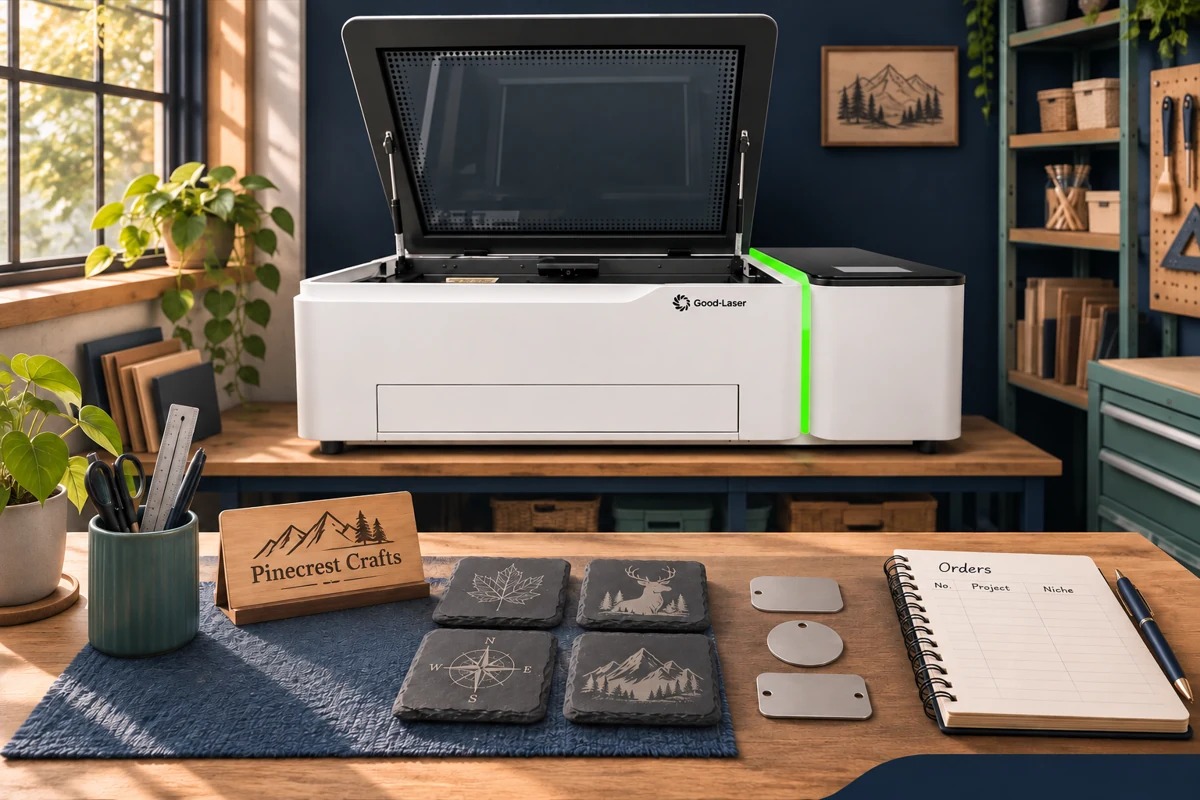
| Business model | Example offer | Work to price carefully |
|---|---|---|
| Personalized gifts | Coasters, small signs, keepsakes | Individual messages, artwork proofs and packaging |
| Corporate and event orders | Staff gifts, awards, place markers | Logo preparation, deadlines and variable names |
| Local engraving service | Marking approved customer-supplied items | Material identification and replacement risk |
| Business identification | Metal nameplates, asset tags and serial numbers | Data checking, fixtures and acceptance requirements |
Pick a buyer, an item and a reason to order. “Personalized closing gifts for local real-estate agents” is easier to test than “custom products for everyone.” Check the alternatives available to that customer, including printed items and suppliers who already offer engraving.
Ask potential buyers what quantity they need, when they order and what makes an existing supplier difficult to use. Take a sample and a proposed price to the conversation. A compliment without a willingness to purchase is useful design feedback, but weak evidence of demand.
The U.S. Small Business Administration's business planning guidance recommends checking demand, competition and pricing while separating startup expenses from recurring costs. Apply that framework to the specific product and customer group you intend to serve.
Write a short business plan that you can test
A first plan can fit on a page if it records the decisions that affect cash and capacity. Give each assumption a way to be checked.
- Customer and offer: who buys, what they receive and why they would choose it.
- Sales route: local outreach, a marketplace, an existing customer base or a direct website.
- Production: material source, equipment, workspace and the expected order workflow.
- Economics: price, variable cost, fixed monthly cost and realistic order volume.
- Validation: the sample orders and measured results needed before spending more.
Separate facts from targets. A supplier quote is evidence of cost; ten orders per week is a sales assumption until customers place those orders. Record both without treating the forecast as secured revenue.
Match the laser to the products you plan to sell
Choose the source for the material and finished effect. Work area, fixture clearance and complete order time then determine whether a machine fits your business.
| Source to evaluate | Typical business direction | Limit to check |
|---|---|---|
| Blue diode | Wood engraving and selected craft materials | Clear acrylic cutting and direct bare-metal work need different evaluation |
| CO₂ | Wood and acrylic products, suitable glass and stone surface engraving | A craft CO₂ machine is not a general bare-metal engraver |
| Fiber | Metal identification, nameplates and personalization | Do not assume the same source replaces a wood or acrylic cutter |
Good-Laser's Blue 530 is a blue diode laser engraver to evaluate for suitable craft work. Light 530 is the CO₂ option to discuss for wood and acrylic projects. Mark M20 is a fiber marking option for metal work. Ask for a sample on the exact material and finish; visually similar items may respond differently.
For an equipment shortlist, use the best laser engraver for small business guide after defining the orders. Request the software, accessories, installation requirements and service terms in the written quotation.
If you plan to sell identification tags, a qr code laser engraver workflow also needs readable codes, correct data and a suitable contrast. An attractive mark is not enough if the customer's intended scanner cannot read it.
Build a startup budget for the installed system
The purchase price is only part of the amount needed to begin taking orders. Budget for a working production area and enough cash to fulfill orders before their proceeds are available.
| Budget group | Include | How to verify it |
|---|---|---|
| Equipment | Machine, required cooling, extraction, fixtures and accessories | Itemized supplier quote |
| Workspace | Suitable bench, electrical provision, ventilation and storage | Site assessment and local quotations |
| Preparation | Computer, software, sample blanks and test material | Current licenses and sample purchasing plan |
| Sales setup | Photography, packaging samples, storefront and initial promotion | Actual channel costs and a spending limit |
| Administration | Registration, applicable permits, insurance and professional advice | Local requirements and written terms |
| Working capital | Inventory, operating bills and a reserve for delays or replacements | Cash-flow plan based on payment timing |
Use the discussion of how much does a laser engraver cost to prepare questions, then price your actual setup. A quotation from another country or an old sale price may omit delivery, taxes, installation or accessories.
If you compare finance options, assess the total payment, deposit, fees and obligations using the actual contract. Keep any financing proposal separate from the machine's quoted cash price. Do not build the plan on a promised payback period.
Price the complete order
Charge for the work required to deliver an accepted product. Include design and customer communication in your time records, even when engraving takes only a few minutes.
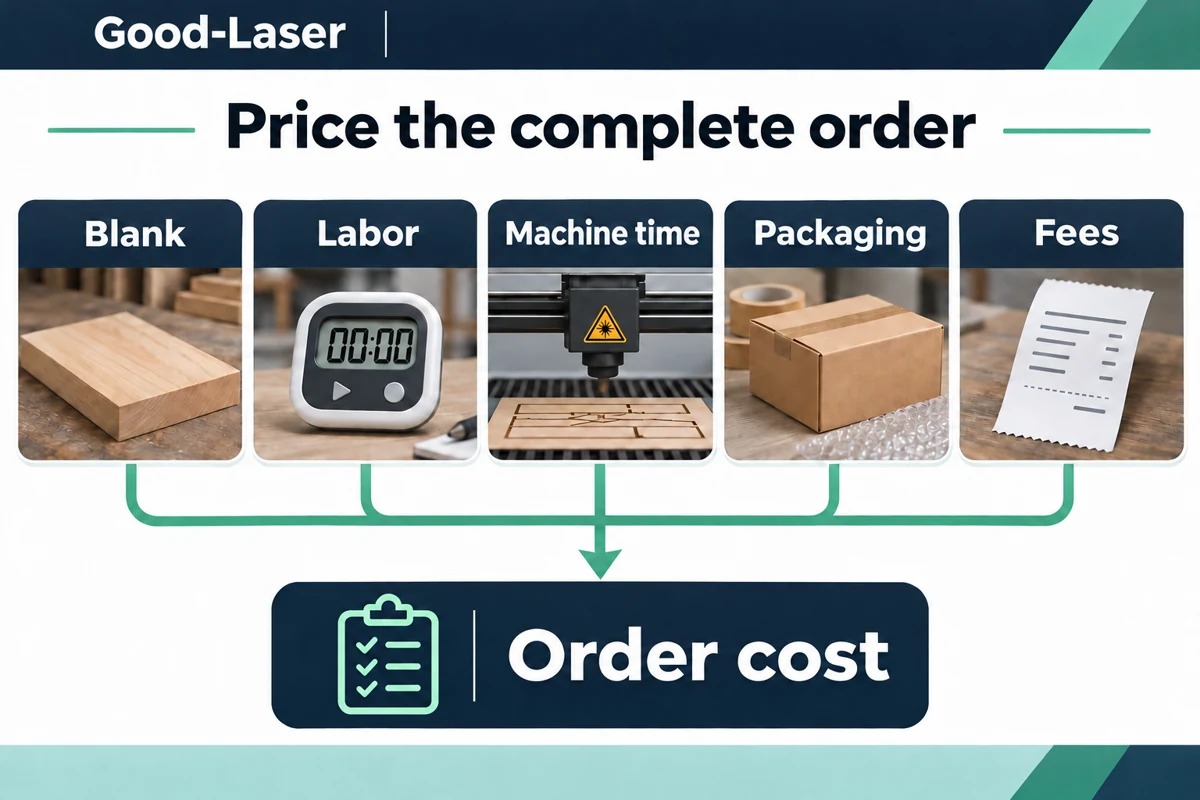
Separate variable costs, which increase with orders, from fixed overhead such as recurring rent or a software subscription. If you allocate fixed overhead through a machine-hour rate, avoid charging it again in a break-even calculation.
A worked pricing example
Suppose you are costing one small personalized gift order. The following figures are hypothetical U.S.-dollar planning inputs, not Good-Laser prices or a typical industry margin.
| Variable cost | Example amount | Assumption |
|---|---|---|
| Blank and consumables | $4.00 | Purchased material used for one order |
| Hands-on labor | $6.00 | 15 minutes at $24 per hour, including allocated proofing time |
| Machine running cost | $1.00 | Illustrative variable energy and wear allowance |
| Packaging | $2.00 | Protective materials and carton |
| Expected rework allowance | $1.00 | Planning allowance to replace with measured data |
| Subtotal before selling fees | $14.00 | Seller-paid delivery would be an additional cost |
Assume, only for this example, selling fees equal 10% of the item price plus $0.30. To retain $10 contribution per order, the price is ($14 + $0.30 + $10) ÷ (1 − 0.10) = $27.00. At that price, fees are $3 and contribution is $10. Replace the assumed fee with your channel's actual fee base and rules.
That $10 still has to cover fixed overhead and profit. If monthly fixed costs are $500, the illustrative operating break-even point is 50 such orders. This excludes startup recovery and tax, and assumes every order has the same cost and price. The owner's production labor is already included in the example; forgetting it makes the result look better than it is.
Use a setup fee or a minimum order value for small jobs with substantial preparation. State how many proofs are included and what happens when a customer changes approved artwork. Batch discounts should follow measured savings in setup and handling.
Build an order workflow you can repeat
Each order should move through the same approval and inspection steps. This matters particularly when names, dates or serial numbers change between pieces.
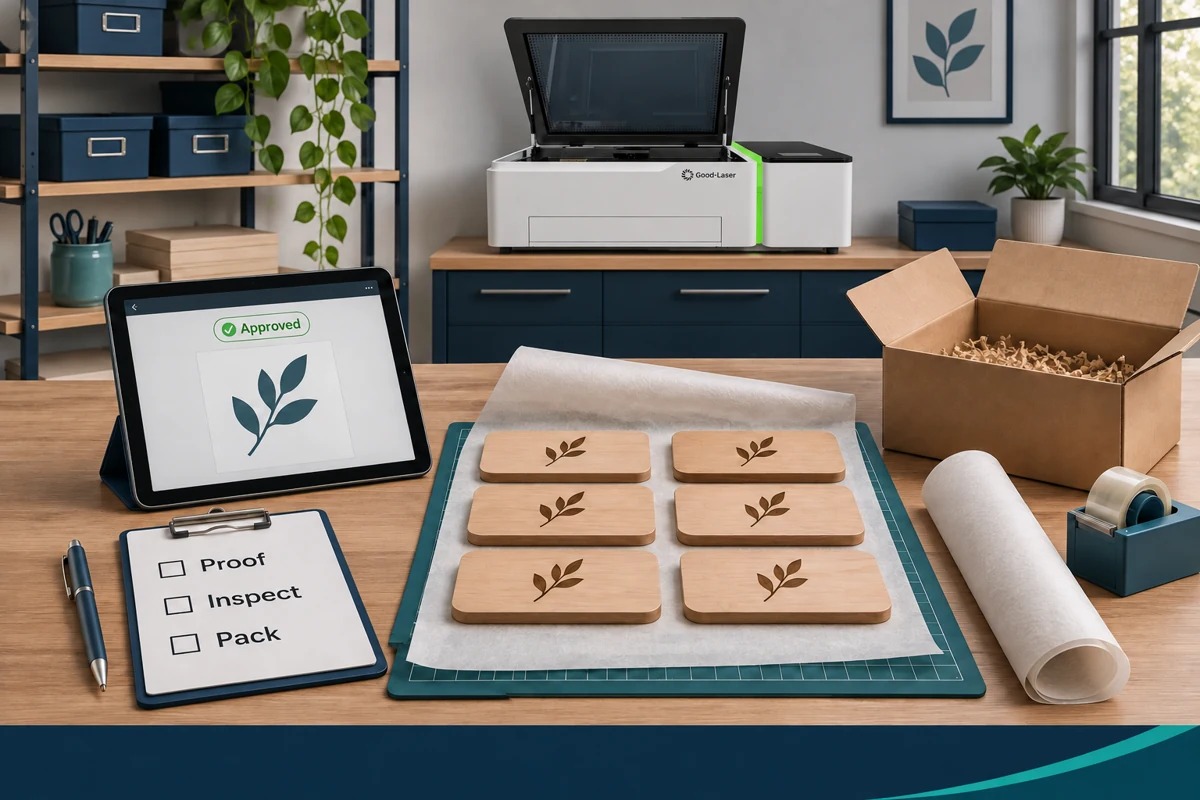
- Collect the material, dimensions, quantity, artwork and deadline before quoting.
- Confirm the material is suitable and agree on the finished result.
- Get approval of spelling, layout and variable data. Save the approved file version.
- Run a first-piece check before completing a batch.
- Inspect appearance, dimensions and any functional requirement, such as code readability.
- Pack, document dispatch and retain the information needed for a reorder.
For customer-supplied products, agree on the testing and replacement-risk policy before accepting them. An unknown coating or an irreplaceable keepsake deserves a different decision from a standard blank with spare stock.
Measure capacity from complete work. If an illustrative 20-piece batch uses 30 minutes of setup and approval, 60 minutes of machine occupancy and 30 minutes of finishing, it consumes two hours when those stages run sequentially. The effective output is ten pieces an hour under those assumptions, even though the engraving stage alone suggests twenty.
Set up the workspace and business requirements
Confirm that the intended space can support the machine, extraction, utilities and access needed for maintenance. Follow the machine's enclosure and interlock instructions and monitor processing. Material compatibility and appropriate fume or dust control need to be settled before production.
For a U.S. business, registration, permits and other requirements depend on location and activities. Check the SBA launch guidance, then confirm the requirements with the relevant local authorities and your insurer. A machine described as compact or suitable for a home workshop does not establish permission to operate a business at a particular address.
Use artwork and fonts that you have permission to use commercially. Ask customers to confirm their authority to supply logos. Keep customer files organized and limit access to personal details used in customized products.
Find the first customers and decide when to expand
Choose one main sales route for the initial test. A local service benefits from physical samples and direct conversations. An online gift range needs clear photography, understandable personalization fields and accurate delivery expectations.
Prepare a few samples, quote real orders and record why buyers accept or decline. Track contribution per order, proofing time, production errors and repeat purchases. A product that attracts many questions but few paid orders may need a clearer offer or a different price.
Expand when orders reveal a specific constraint. More equipment can help when the machine is consistently occupied with profitable work. It will not solve poor conversion, unclear proofs or a finishing process that takes most of the day. Outsourcing an occasional unusual job may be more sensible than buying a second source immediately.
Frequently asked questions
Is a laser engraving business profitable?
It can be, but profitability depends on the offer, demand, pricing and production discipline. Calculate contribution after materials, labor, fees and rework, then subtract fixed overhead. A large difference between blank cost and selling price is not a reliable profit measure, especially for custom orders that need substantial communication.
How much money do I need to start?
Build the figure from an installed equipment quote, workspace costs, software, test materials, sales setup and working capital. A small existing workshop and a newly rented commercial space have different requirements. Use actual quotations and a cash-flow plan instead of treating a machine-only price as the startup budget.
Can I start without owning a machine?
You can test products through a suitable production partner or a properly supervised shared workshop. Confirm permission for commercial work, available materials, turnaround and quality responsibility. This approach can help test an offer before equipment purchase, although partner costs and scheduling still belong in your pricing.
Should I sell products or offer engraving services?
Standard products make materials and settings easier to repeat. Services can attract customers who already own the item, but they add material uncertainty and replacement risk. Start with the model that matches your skills and customer access, then add the other only when you can quote and control it reliably.
Should I charge by the minute or by the product?
Use time internally to understand costs, then choose a customer-facing price structure that fits the order. Standard gifts can have a product price and defined personalization options. Unusual service jobs may need a setup charge and a job quotation. Machine minutes alone omit artwork, handling and responsibility for the result.
When should I buy a second laser?
Consider it when measured demand requires another material process or when profitable orders exceed the capacity of the current machine. Compare the added contribution with the full cost of equipment, space and operation. A second machine adds little value if your main delay is customer approval or packing.
Turn the business plan into a Good-Laser sample request
Send the good laser team your first product list, material details, artwork sizes, expected batch quantities and workspace constraints. Ask which configuration should be tested and what the complete setup includes. A representative finished sample and a written quote will give your budget firmer inputs.