Laser engraved stone products: market trends and ideas for 2026
The most useful laser engraved stone products market trends for 2026 are personalized keepsakes, gift sets and small business branding. Slate coasters, photo plaques and table signs are practical products to test. Demand still needs local validation: broad personalization trends do not establish the size or profitability of the engraved-stone market.
A good stone product needs readable engraving, reliable blanks and packaging that survives delivery. Before expanding a range, work out who will buy each item, what makes it worth ordering and how much time the complete order takes.
What the 2026 trends tell a stone engraving business
Personalization offers several directions for a small stone range, but the strongest evidence concerns the wider gifting market. Etsy's fall and winter 2026 seller report identifies interest in gifts for friends, pets and chosen family, alongside products for gatherings. These are marketplace signals, not stone-specific sales forecasts.
For an engraver, that suggests testing a pet portrait on slate, a set of coasters with different family names or a gift for a new home. The material adds texture and weight; the design gives the buyer a reason to choose that particular item. A stone blank with a generic slogan still competes with many inexpensive alternatives.
Personalization with a clear occasion
Build the offer around a recognizable purchase: a housewarming, a wedding party thank-you or a remembrance gift. Show the size, personalization limits and packaging before checkout. A buyer should know whether the price includes photo preparation, one proof or several revisions.
Sets that reduce the buyer's work
A coordinated coaster set, protective backing and a suitable box can make a more complete gift. Test the price of the whole set against the extra labor and shipping weight. A larger order value is useful only if it leaves enough contribution after those costs.
Repeat orders from local organizations
Cafes, accommodation providers and event organizers can be approached with samples of table signs, desk gifts or branded coasters. Their requirements differ from individual gifts: consistent appearance, reorder availability and a clear approval process often matter more than a different design on every piece.
Material provenance and careful claims
Buyers may ask where the stone comes from or whether packaging is recyclable. Keep supplier records and describe what you can verify. Natural stone, a reusable product or a plastic-free box does not by itself establish a low environmental footprint. Weight, sourcing, coatings and transportation still matter.
Stone products worth testing in 2026
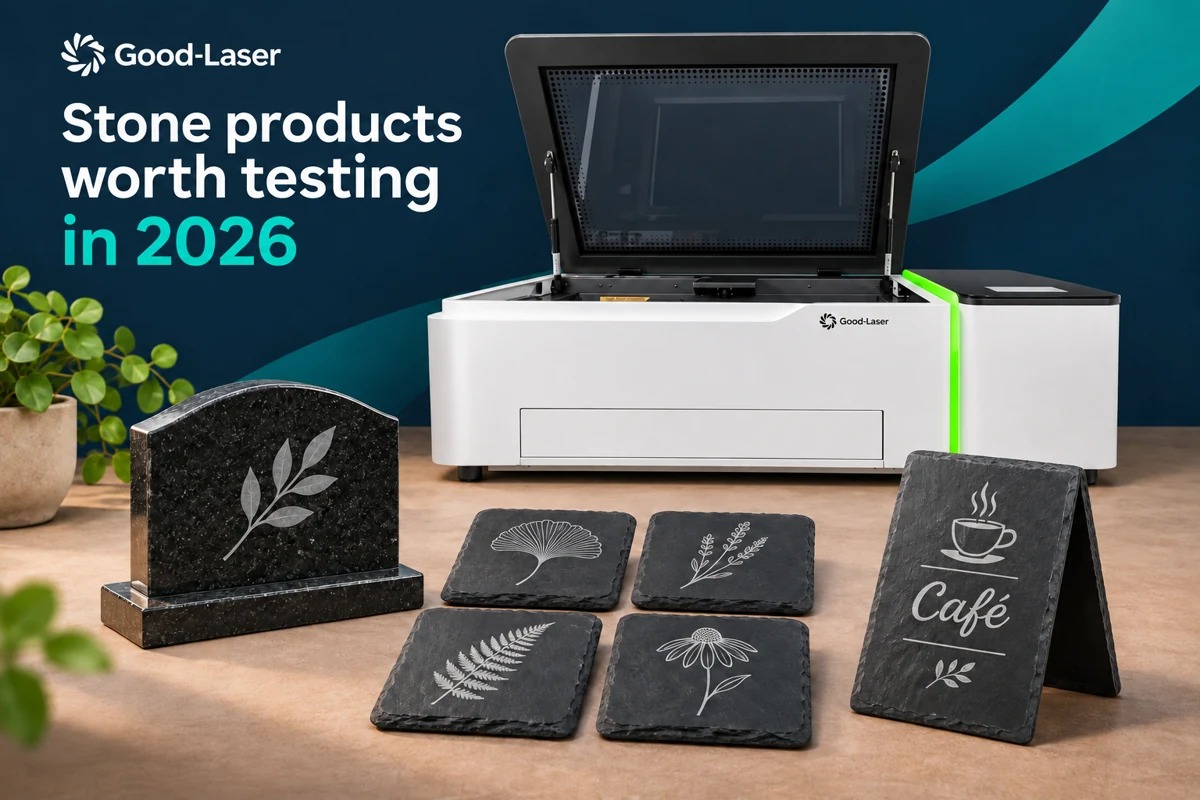
| Product | Likely buyer | What to validate |
|---|---|---|
| Personalized slate coaster sets | Gift buyers, cafes, company gift teams | Flatness, backing, readable artwork and packed weight |
| Pet portrait or remembrance plaques | Pet owners and specialist gift shops | Photo quality, tonal detail, proof approval and handling |
| House numbers and small signs | Homeowners and accommodation providers | Viewing distance, mounting method and outdoor exposure |
| Wedding place markers | Couples and event planners | Name accuracy, consistent sizing and deadline capacity |
| Desk plaques and recognition gifts | Local employers and clubs | Logo permission, display stand and repeat availability |
| Garden markers and decorative stones | Gardeners and local retailers | Stone variation, readable lettering and weathering |
Begin with a small range that shares a blank size and a manageable proofing process. Coasters are easier to standardize than a collection of irregular rocks. A detailed portrait can command more attention, but image cleanup and approval may take longer than engraving.
Keep memorial work separate from routine promotional orders. Confirm spelling and dates in writing, provide a clear proof and discuss whether the piece will be displayed indoors or outdoors. Do not promise lifelong contrast from a photograph of a new sample.
Choose stone for contrast and consistency
Dark, reasonably uniform stone often makes a light surface mark easier to read. Mineral composition, surface finish and flatness affect the result, so two blanks sold under the same stone name may need different treatment.
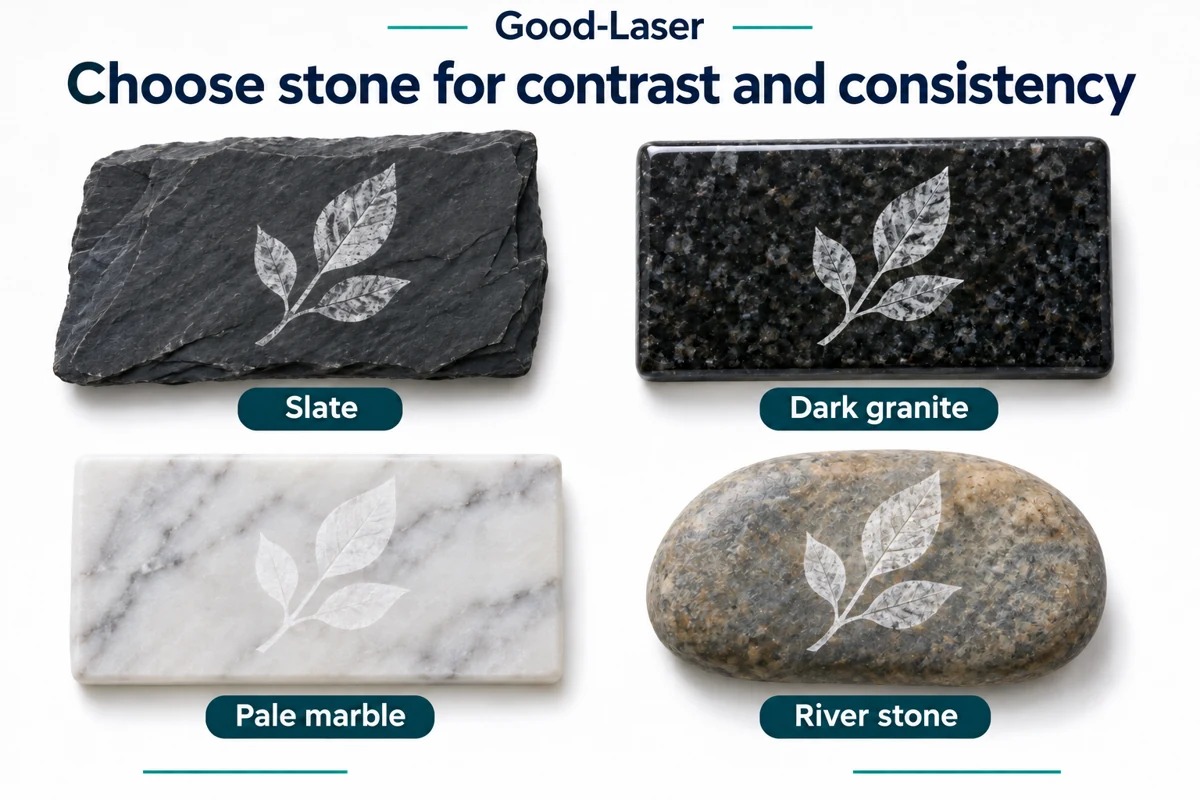
| Material | Useful starting application | Main limitation |
|---|---|---|
| Slate | Coasters, compact signs and keepsakes | Uneven thickness, flaking edges and variable texture |
| Polished dark granite | Photo plaques and display pieces | Mineral pattern can interrupt fine tonal detail |
| Marble | Decorative plaques and lettering | Veins and pale backgrounds can reduce contrast |
| River stone | Small decorative markers | Curvature, unknown composition and difficult positioning |
The manufacturer guidance on stone surface preparation and testing emphasizes flat surfaces, material variation and test patterns. Its published settings belong to specified equipment and samples. Copying a power percentage to a different laser does not reproduce that test.
Buy blanks with known composition and surface treatment. Ask about sealants, resin fillers and backing before processing. Engineered stone and coated decorative tiles need their own material review; their appearance alone cannot establish laser compatibility.
For machine selection, the stone engraving laser application page provides a useful starting point. Bring an actual blank to the sample discussion, including its thickness and weight.
Build a repeatable stone engraving workflow
Approve a sample from the intended blank supplier before quoting a production batch. Record enough information to repeat the job when the next order arrives.
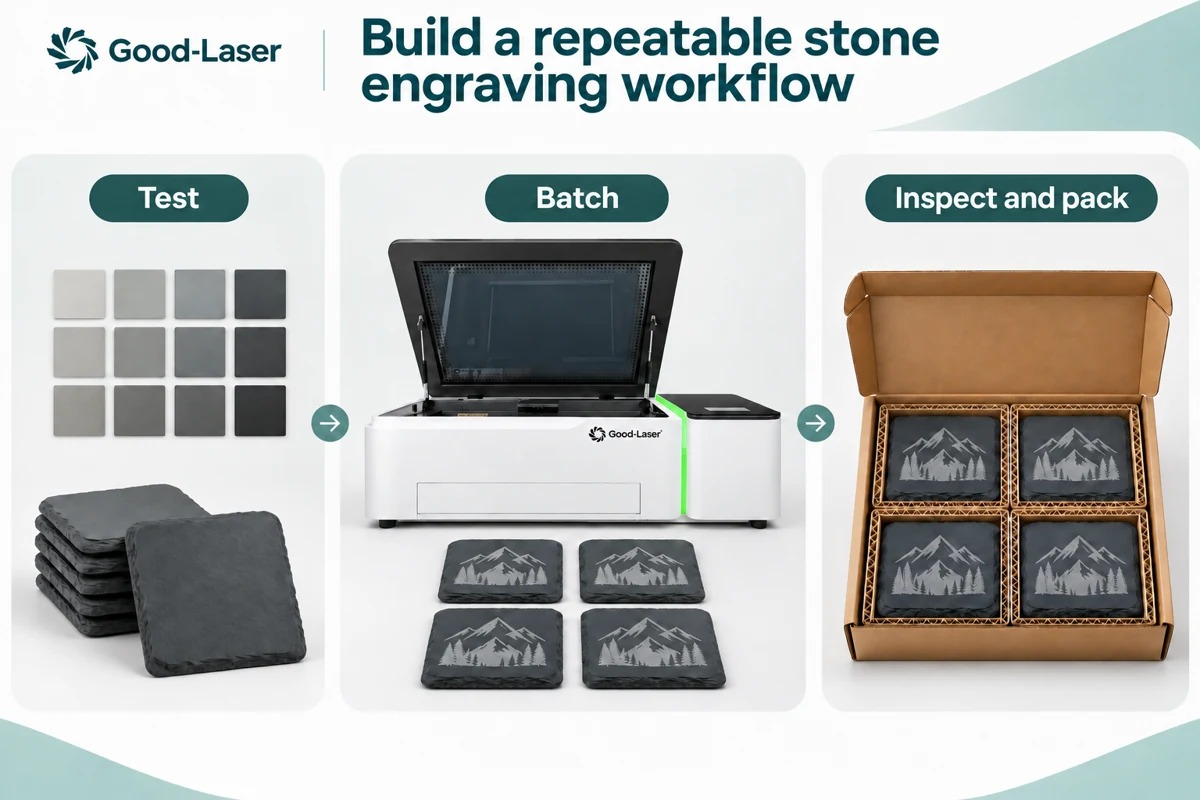
- Inspect the blanks for cracks, flatness, finish and dimensional variation. Identify pieces unsuitable for the order.
- Clean and prepare the material according to the supplier and machine guidance. Confirm that the surface treatment is approved for laser processing.
- Test a small pattern containing fine text, solid areas and a tonal gradient. Use a spare piece from the same batch.
- Secure the blank and confirm focus across the engraving area. An irregular stone needs a stable fixture.
- Approve the finished appearance after cleaning. Photograph it under ordinary light, without editing away poor contrast.
- Record the file version, machine configuration, settings, blank batch and accepted result. Inspect the finished batch before packing.
For photographs, start with a sharp image and simplify distracting backgrounds. Test the image-processing method and tonal direction on the stone. More dots per inch do not automatically produce a better portrait; extra overlap can lose detail.
Stone processing produces dust. Plan suitable extraction and cleanup with the equipment supplier, follow the machine instructions and avoid dispersing settled dust into the room. Check optics and the work area at the intervals specified for the process.
Evaluate finishing separately. A compatible color fill or sealer may change contrast, gloss and outdoor behavior. Apply it only through an approved process, and test the finished product under its intended conditions. Do not describe an unverified coating as food-safe.
Price stone products after labor, rejects and delivery
A blank-to-selling-price comparison leaves out much of the work. Record artwork preparation, messages, proof revisions, setup, engraving, cleaning, inspection and packing. Include replacement blanks and the cost of correcting an incorrect name.
Use this order-level calculation: selling price minus materials, paid or owner labor, machine running costs, packaging, sales fees and delivery paid by the seller equals the contribution available for fixed overhead and profit. Keep fixed overhead separate if you use that contribution to calculate break-even volume.
A hypothetical coaster order priced at $36 with $23 in these variable costs contributes $13 before fixed overhead and tax. Those numbers illustrate the calculation; they are not observed selling prices or a forecast. If proof revisions add another $6 of labor, contribution falls to $7.
Weigh and pack a real sample before setting shipping charges. Protective inserts, heavier cartons and replacements for transit damage can change the economics of stone substantially. Test both individual and set packaging.
Equipment is another budget item. The guide to how much does a laser engraver cost can help frame a quote discussion, but obtain a current installed-system quotation for the configuration you need.
Validate demand before expanding the range
Offer a few finished samples to a defined audience and measure paid interest. Social engagement can help choose a design, but it does not show what buyers will pay after delivery charges.
For consumer sales, photograph the real surface and include scale, personalization choices and turnaround conditions. For local business sales, prepare a sample, minimum-order policy and reorder quotation. Track inquiry-to-order conversion, contribution per order, hands-on minutes, reject rate and repeat orders by product.
Keep the range narrow until one product earns repeatable orders at an acceptable return for your time. If machine capacity becomes the constraint, compare the best laser engraver for small business criteria against those measured orders.
Frequently asked questions
Is there reliable market growth data specifically for laser engraved stone products?
Broad laser-equipment and personalized-gift reports do not measure the same market as engraved stone products. Use them as context and check their definitions. For a small shop, paid sample orders, repeat purchasing and product-level contribution provide more useful evidence than applying a broad market growth rate to a slate range.
Which stone product is easiest to standardize?
Flat slate coasters from a consistent supplier are a practical starting point because the outline and artwork area can be repeated in a fixture. Inspect thickness and edges, test the backing and allow for rejected blanks. A standard shape reduces setup variation but does not eliminate material variation.
Can a laser cut stone into custom shapes?
Desktop engraving lasers are used for surface marking and shallow engraving on suitable stone. Do not plan a product around cutting stone slabs with a desktop CO₂ engraver. Purchase appropriately shaped blanks or use a suitable stone-cutting supplier, then validate the engraving process on the finished blank.
Do engraved stone products need a sealer?
That depends on the stone, the desired appearance and the intended use. A sealer can change contrast and sheen, so assess an untreated sample alongside the proposed finished version. Verify product compatibility and any food-contact or outdoor-use claims with the relevant supplier before making those claims to buyers.
Can stone photo engraving be profitable?
It can generate a positive contribution if the selling price covers photo preparation, proofing, production, rejects, packaging and selling costs. Time a complete sample order. A portrait requiring extensive editing needs a different price and revision policy from a standard name-and-date design on the same blank.
Which laser should a stone gift business evaluate?
A CO₂ system is a common starting point for stone surface engraving, especially when the shop also works with wood or acrylic. Confirm the actual stone result, usable work area, clearance, load support and extraction. A generic material list is insufficient evidence for a particular stone and artwork combination.
Plan a stone sample with Good-Laser
For a compact gift range, discuss a Light 530 CO₂ setup with the good laser team. Send the stone type, blank dimensions and weight, artwork, intended use and expected batch size. Ask for a sample assessment and a configuration quote based on the finished result you need before committing to production.