Fiber Laser Marking Machine: Benefits, Applications and Buying Guide
A fiber laser marking machine can apply part numbers, logos and traceability codes to suitable metals. Choose it by the finished mark you need: contrast, depth, size and durability. Then compare tested cycle time, working area, part handling and software. A wattage figure cannot tell you how the complete production process will run.
A short serial number on a flat aluminum tag is a different job from a recessed logo on a curved component. Both may be described as metal marking, but they need different sample tests and sometimes different fixtures or laser configurations.
Define the mark before choosing the equipment
Marking is a broad term. The process may change a surface's appearance, remove a coating or remove metal to create a recess. Specify what the drawing requires and how the mark will be inspected. If depth matters, include a measurable depth requirement instead of asking for a “strong” engraving.
For a barcode or data code, define its actual size and the reader used in production. A code that looks sharp in a photograph may still be difficult to read under glare or after cleaning. For a logo, the acceptance test may instead focus on color consistency, edge quality and visibility.
Good-Laser's laser engraver for metal information is a useful starting point for matching the material to the process. Include the alloy, coating and surface texture in the enquiry; “stainless steel” or “aluminum” is only part of the specification.
Where fiber laser marking offers practical benefits
The laser applies the mark directly to the part without a physical cutting tool contacting the marking area. Digital artwork makes it practical to change a name, serial number or logo between jobs. Measure the loading and inspection routine too when deciding whether this will save time.
For small industrial components, consistent positioning can be as valuable as short marking time. A fixture that makes the part's orientation obvious reduces the chance of a clear mark being placed on the wrong face. For personalization, an approved artwork file can make a repeat order easier to set up.
Direct marking also avoids an adhesive label in applications where labels are inconvenient. That does not make every laser mark indestructible. Wear, cleaning chemicals, surface treatment and later machining can alter the mark. Include the relevant exposure in your acceptance test.
| Application | Useful outcome | What to prove with a sample |
|---|---|---|
| Asset tags and nameplates | Readable identification on the part | Contrast at the intended viewing angle |
| Tools and machined components | Part numbers that fit a small area | Readability after the specified cleaning or wear test |
| Electronic housings | Compact codes and product details | Correct data, placement and coating response |
| Personalized metal gifts | Repeatable names and artwork | Fine detail on the actual finish |
| Recessed identification | A measurable engraved feature | Depth, surface condition and complete cycle time |
Match the working field to the part
A galvo marking field is the area the optical system can address in one setup. It is not the same as the maximum size of an object that can physically sit on the machine. Check the artwork area, part height, focus access and fixture clearance separately.
For a batch fixture, place the test marks where production parts will actually sit. Compare results near the center and the intended field edges. If the proposal involves changing lenses or repositioning the part, have that procedure demonstrated and included in the time estimate.
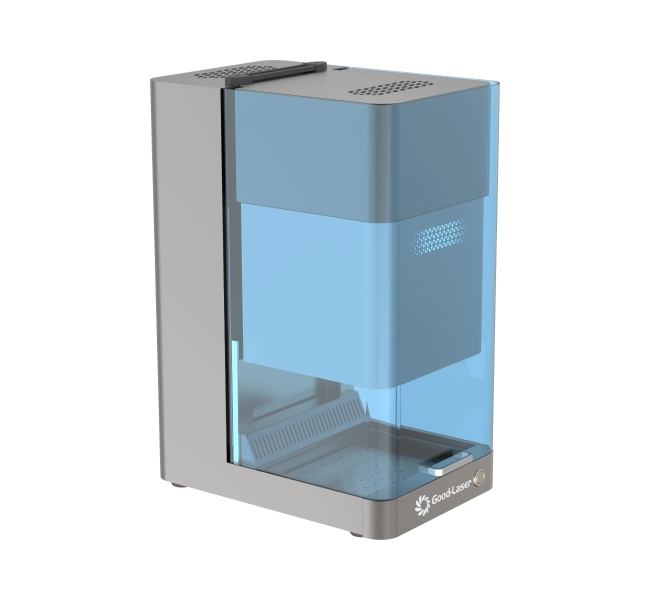
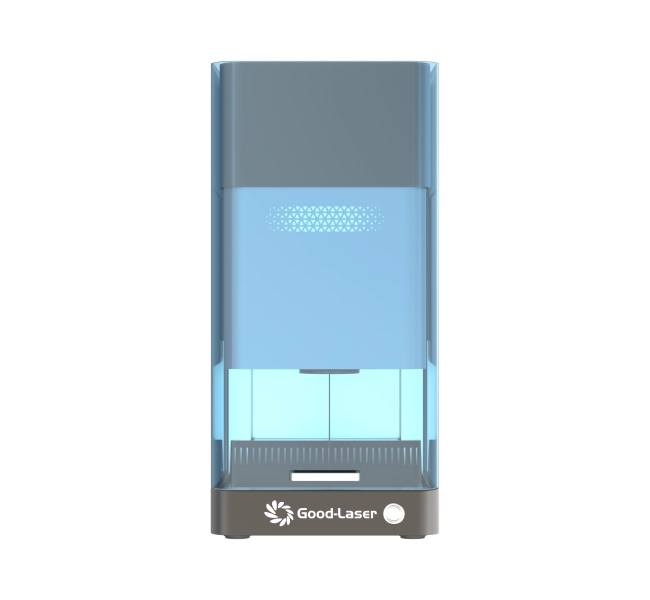
Good-Laser lists 20 W, 30 W and 50 W options and a 110 × 110 mm marking area for the Mark M20 fiber laser engraver. Its current specification lists Mantismark software. Confirm the source, lens, software version and included fixtures for the quoted configuration rather than assuming every option is supplied together.
Compare power with the same artwork and material
A fair demonstration uses the same part, artwork, mark quality requirement and cleaning routine. Ask each proposed configuration to produce an acceptable result, then compare elapsed time. A faster demonstration is not useful if it leaves unreadable text or requires additional finishing.
Do not choose a higher-power unit solely because its maximum scan-speed figure is larger. The head may not spend the whole job moving at that figure. Filled areas, repeated passes and small details affect the actual cycle.
Pulse characteristics also matter for some finishes. If a supplier proposes a particular source for a dark mark or a color effect, request evidence on your material. A generic “fiber laser” description does not establish adjustable pulse-width capability, MOPA configuration or a guaranteed color palette.
Include software and data handling in the trial
A useful software demonstration begins with your files. Check imported dimensions, fonts, filled regions and the operator's route from opening the job to marking a part. For variable information, bring a small test dataset with the same format as your production records.
Ask the supplier to demonstrate sequence handling if you need automatic serial numbers. What happens after a rejected part, an interrupted job or a repeated order? Confirm how the operator can avoid duplicates and how the system records what was marked. These are requirements to verify, not features to assume from a product category.
For electronic components, Good-Laser's application information includes the laser serial number engraver use case. Follow that discussion with a test on the actual housing or component; a printed circuit board, coated enclosure and metal connector are different materials.
Make handling and inspection part of the cycle time
Time from picking up the unmarked part to placing the accepted part in its tray. Include loading, positioning, marking, unloading and inspection. If one stage dominates the cycle, more laser power may have little effect on daily output.
As an illustrative example, a five-second mark with fifteen seconds of handling creates a twenty-second station cycle before interruptions. Reducing the mark to three seconds saves two seconds per cycle, not two-fifths of the total production time. Use a measured trial to find the stage worth improving.
Inspect more than the most attractive sample. For a small trial batch, compare early and late pieces, check loading repeatability and scan every required code. Agree on the acceptance rule before the trial so the result is not judged only by a sales photograph.
Installation and operating costs
Specify the enclosure, interlocks, extraction and operating procedure appropriate to the supplied laser and your premises. Do not infer the accessible laser classification from a product photograph. The supplier should explain the complete protective arrangement and the documentation supplied with it.
Request separate costs for fixtures, training, software options and replacement items. If you need a rotary or other laser engraver accessories, confirm compatibility with the exact machine and control software. An accessory shown elsewhere in the catalogue is not proof that it fits your configuration.
Frequently asked questions
Is fiber laser marking the same as deep engraving?
No. Marking can mean a visible surface change or coating removal, while deep engraving removes material to a specified depth. The same general machine category may support several processes, but the settings and time differ. Include the required depth and inspection method in the sample request.
Is a 20 W fiber laser enough for metal marking?
It may be enough for a particular surface mark, but power alone cannot answer the question. The alloy, finish, image size and cycle-time target all matter. Test the proposed configuration on your parts and compare the accepted result with higher-power options only if there is a production reason to do so.
Can a fiber machine replace a CO2 laser cutter?
Not across the usual workload of wood, acrylic and other nonmetal sheet cutting. A metal-marking system and a CO2 cutter serve different processes. Define the proportion of metal identification versus nonmetal cutting in your orders; some workshops need separate equipment rather than one machine advertised for many materials.
Are laser marks permanent?
They can be durable, but permanence is a performance requirement to test. A mark may be affected by abrasion, corrosion, aggressive cleaning or removal of the marked coating. Use the finished part and the expected service conditions when checking durability, and keep the approved test result with the job specification.
Does every fiber laser produce colored metal marks?
No. Color depends on the material, surface condition, source characteristics and process. Do not assume color capability from the word “fiber” or from a picture of a sample made on another configuration. Ask for a repeatable demonstration on your material and confirm exactly which source and settings produced it.
Send Good-Laser your part drawing, alloy, surface finish, artwork and required daily quantity. Reviewing laser engraving samples against a defined acceptance test can help narrow the configuration before you request a final quotation.