Laser Etching vs Engraving: A Practical Comparison Guide
Laser etching and laser engraving differ mainly in how they change a surface. In metal marking, etching commonly describes shallow surface melting or texturing, while engraving removes material to form a recess. Choose by the required contrast, depth, finish and service conditions, because suppliers do not always use these terms consistently.
A logo on a coated gift and a recessed serial number on a metal component may both be advertised as “laser etched.” Before choosing equipment, define the result you need. This guide explains the practical differences and how to discuss them with a laser engraving machine manufacturer.
Laser Etching vs Engraving: The Main Differences
Etching generally emphasizes a surface effect; engraving emphasizes material removal. That distinction is useful for comparing metal processes, but it should not be treated as a universal description of every material sold as laser etched.
| Decision factor | Laser etching | Laser engraving |
|---|---|---|
| Typical metal process | Shallow melting or surface modification that changes texture and appearance | Removal of material to produce a recess |
| Main result | Visible contrast or a textured surface | Recessed text, graphics or another defined feature |
| Depth | Usually a surface-focused effect; terminology varies | Specify the required depth rather than assuming a standard value |
| Processing time | A shallow result can require less processing than a deep recess | Greater removal can require additional passes and time |
| Durability assessment | Test retained contrast under the intended use | Test both the remaining recess and its readability |
| Best purchasing evidence | A representative sample with agreed appearance criteria | A representative sample with depth and finish measurements |
The useful question is not simply which process is better. It is whether the result remains readable, fits the design and can be repeated at the output your business needs.
What Is Laser Etching?
For metal marking, laser etching commonly refers to changing a thin surface region through localized heating. Melting and changes in surface texture can alter how light reflects, creating visible contrast. Laserax's technical explanation of laser etching describes this metal-focused use of the term.
An etched feature may be slightly raised or textured rather than forming a substantial cavity. However, “etching” also appears in descriptions of coating removal and decorative glass work. Those applications do not necessarily use the same mechanism as metal surface melting.
When reviewing a quotation, ask what the laser changes: the base material, an oxide layer, paint, plating or another coating. That answer is more useful than the word “etching” alone. It also helps establish whether preparation or cleaning is part of the quoted process.
What Is Laser Engraving?
Laser engraving removes material from the workpiece to create a recessed feature. The result can be shallow lettering or a deeper relief, depending on the material, laser source, optics and processing strategy. Engraving is therefore a process category, not a guarantee of a particular depth.
For a depth-controlled project, put the dimension and tolerance on the drawing or sample brief. State whether the measurement applies to the deepest point, an average area or the usable floor of a feature. These are purchasing requirements to agree with the supplier, rather than assumptions to make from a photograph.
Removing more material can increase cycle time. Ask for the finished result at the required depth before comparing speed claims. A fast surface logo and a deeply engraved logo are different jobs, even if their artwork is identical.
Is Etching the Same as Marking or Annealing?
Laser marking is often used as an umbrella term for producing identification with a laser. Engraving, surface texturing, coating removal and color-changing processes can all serve that purpose. Some suppliers use “marking” more narrowly, so confirm the intended result.
Annealing is another distinct option for suitable metals: controlled heating can produce an oxide-based color change without the material removal associated with engraving. A dark mark does not automatically mean that a recess has been formed. Nor does a dark appearance by itself demonstrate corrosion resistance.
Chemical etching is different again. It uses a chemical process rather than laser energy. If an existing drawing calls for an etched feature, confirm whether laser processing is acceptable before replacing the specified manufacturing method.
How the Material Changes the Comparison
Always compare samples made from the same material and surface finish. “Metal,” “plastic” and “glass” describe broad groups, not a single predictable response.
| Material or finish | What to clarify | What to approve on a sample |
|---|---|---|
| Bare stainless steel or other metal | Surface contrast, texture or a measurable recess? | Readability, required depth and acceptable surrounding finish |
| Anodized aluminum | May the protective layer be altered or removed? | Contrast and the specified condition of the anodized surface |
| Painted or powder-coated metal | Is the job coating removal or engraving the substrate? | Clean edges, residue and the effect on exposed material |
| Wood and acrylic | Which exact stock, finish and engraving appearance are required? | Detail, visual consistency and any specified recess |
| Glass | What surface effect is intended, and is the item suitable? | Frosted appearance, edge quality and unacceptable chipping |
Bare metal versus coated metal
A logo exposed by removing paint is not proof that the same machine can engrave a useful depth into the metal underneath. Identify the alloy and every surface layer before selecting a laser engraver for metal. For plated gifts, also state whether exposing the base metal is acceptable.
On anodized aluminum, appearance and protective-layer requirements must be considered together. Do not approve a sample on contrast alone if the drawing requires the coating to remain intact. Ask the supplier how that requirement will be checked.
Wood, acrylic and glass
Do not apply the metal “melting versus removal” explanation to every non-metal. Wood engraving involves a different material response, while acrylic results depend on the stock and laser process. For glass, CO2 surface engraving can produce a frosted appearance through surface disruption, including microscopic fractures. It should not be assumed to create the same kind of recess as metal engraving.
Use the actual product blank for evaluation. A flat offcut can help develop a process, but it does not prove the result on a curved drinking glass, a coated panel or a finished object with limited working clearance.
Which Process Lasts Longer or Costs Less?
A deeper recess can provide an advantage when surface wear is expected, but depth alone does not guarantee a readable mark for a particular service life. An etched mark may be sufficient where abrasion is limited. Evaluate both against the actual application.
For example, a decorative nameplate used indoors and a component that will be polished after marking need different acceptance checks. If a later operation removes material, test the mark after that operation. If the product will be coated, confirm that the completed coating does not make the identification unreadable.
Similarly, there is no universal etching-to-engraving price ratio. Quote the same artwork size, material, quantity and required finish. Include handling, fixtures, cleaning, inspection and any rework. A short laser cycle can lose its apparent cost advantage if positioning each part takes much longer.
For barcode or Data Matrix applications, test the actual code with the intended reader. A dark square that looks clear in a close-up image may still be unsuitable at the intended size or viewing angle.
Choosing a Good-Laser Machine for the Required Result
Select the laser source for the material and process, then confirm the machine configuration on a sample. “Etcher” and “engraver” are not sufficient equipment specifications. The following Good-Laser products are starting points for discussion, not a claim that every model performs every process.
Mark M20: Start with the fiber range for metal work
The Mark M20 appears in Good-Laser's fiber laser marking machine series. For metal identification or personalization, ask the team to demonstrate the required surface finish or recess on your production material.
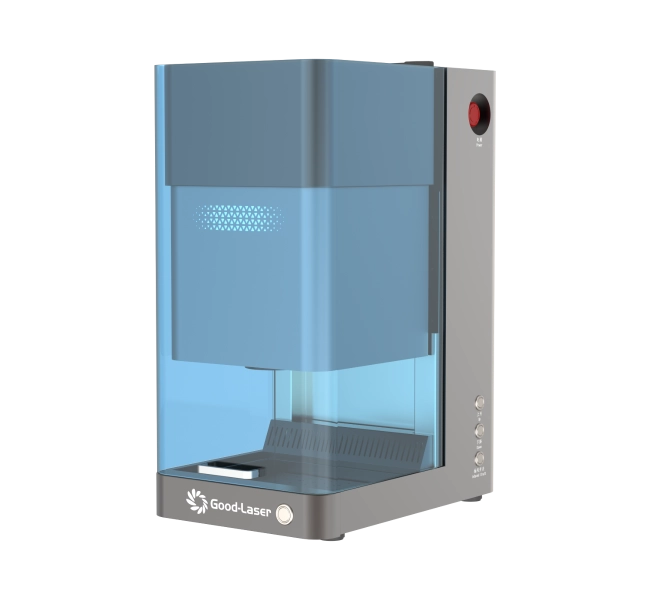
Confirm the supplied source, power, lens, working clearance and software in the quotation. Do not infer MOPA capability, a guaranteed depth or a production rate from the model name. The machine's suitability depends on the agreed result and configuration.
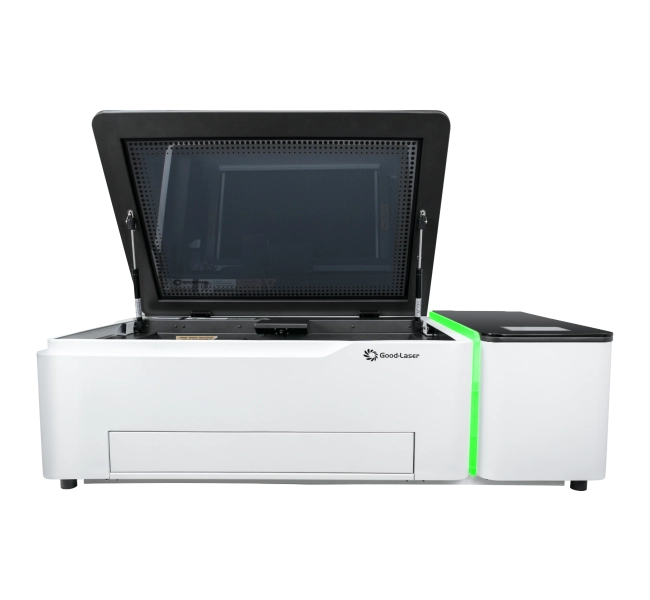
Light 530: Evaluate CO2 for suitable non-metal projects
The Light 530 is part of Good-Laser's desktop laser engraver and cutter range. It is a relevant discussion point for suitable wood, acrylic and other non-metal projects. Confirm compatibility with the exact stock and the intended engraving or surface effect.
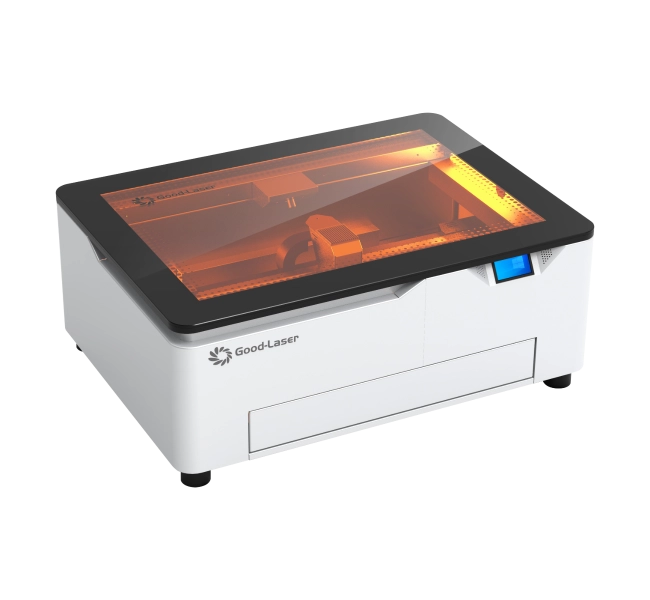
Light Blue 530: Compare a blue-light option for craft work
Good-Laser's blue laser engravers and cutters include the Light Blue 530. For craft-oriented projects, compare a representative sample, usable workspace and workflow. Confirm any coated-metal application separately; a coating-removal result does not establish bare-metal engraving performance.
What to Put in an Etching or Engraving Sample Request
Give every supplier the same brief. This makes the comparison useful and reduces the chance of receiving attractive samples that do not answer your production question.
| Include in the brief | Example of the required information | Acceptance check |
|---|---|---|
| Material and finish | Alloy or material grade, coating and actual blank | Sample represents production stock |
| Artwork and dimensions | Final text, code or logo at the intended size | Detail and placement meet the drawing |
| Required result | Contrast, texture or specified engraving depth | Agreed visual or dimensional inspection |
| Later operations and use | Cleaning, polishing, coating or expected wear | Identification remains acceptable afterward |
| Output and installation | Batch quantity, handling method and available workspace | Complete cycle and installation requirements are understood |
Keep an approved sample and record the configuration used. Request a repeated run to check consistency, then use the same acceptance method when the equipment is delivered. Follow the manufacturer's instructions for guarding, extraction and approved materials when setting up the process.
Frequently Asked Questions
Is laser etching better than laser engraving?
Neither is better for every job. A surface-focused process can suit visible identification where substantial depth is unnecessary. Engraving is relevant when you need a recess. Compare the finished result, later processing and complete cycle time rather than selecting a method solely from its name.
Does laser etching remove material?
In the common metal-melting definition, etching primarily modifies the surface rather than creating a deep cavity. However, suppliers also use the term for shallow removal or coating-related work. Ask which layer changes and whether material is removed when reviewing a specification or quotation.
How deep are laser etching and engraving?
There is no single depth boundary used consistently across all materials and suppliers. Treat published depth ranges as context for a particular process, not a universal standard. If depth matters to your part, specify the required dimension, tolerance and measurement method, then approve a measured sample.
Can the same machine etch and engrave?
A suitable laser system may produce different effects by changing its processing strategy and settings. That does not mean every machine can create every finish or depth. Confirm the laser source, material, optics and available controls, and ask for both required results on representative samples.
Does laser etching wear off?
An etched feature is a physical surface change, but its visibility can still deteriorate through wear, corrosion or later finishing. A deeper engraved feature can also lose readability. Assess the mark under the product's actual conditions instead of interpreting “permanent marking” as an unlimited durability promise.
Is laser etching cheaper than engraving?
A shallow surface effect may require less processing than deep engraving, but the finished-part cost also includes setup, loading, cleaning and inspection. Compare quotations for the same material, artwork and acceptance criteria. A cheaper process is useful only if the delivered result meets the requirement.
Discuss the Right Process with Good-Laser
The practical choice between laser etching and engraving starts with the finished part: what should change, how it should look and whether a measurable recess is required. Once that is clear, selecting the machine and comparing samples becomes much easier.
Request a laser engraving machine quote from Good-Laser with your material, surface finish, artwork, part dimensions, desired effect and expected quantity. Ask the team to review a suitable fiber, CO2 or blue-light option and confirm the sample result and included configuration before you decide.